
The Next Shift in Fashion Sourcing Could Traceability Change How Fashion Brands Choose Suppliers?
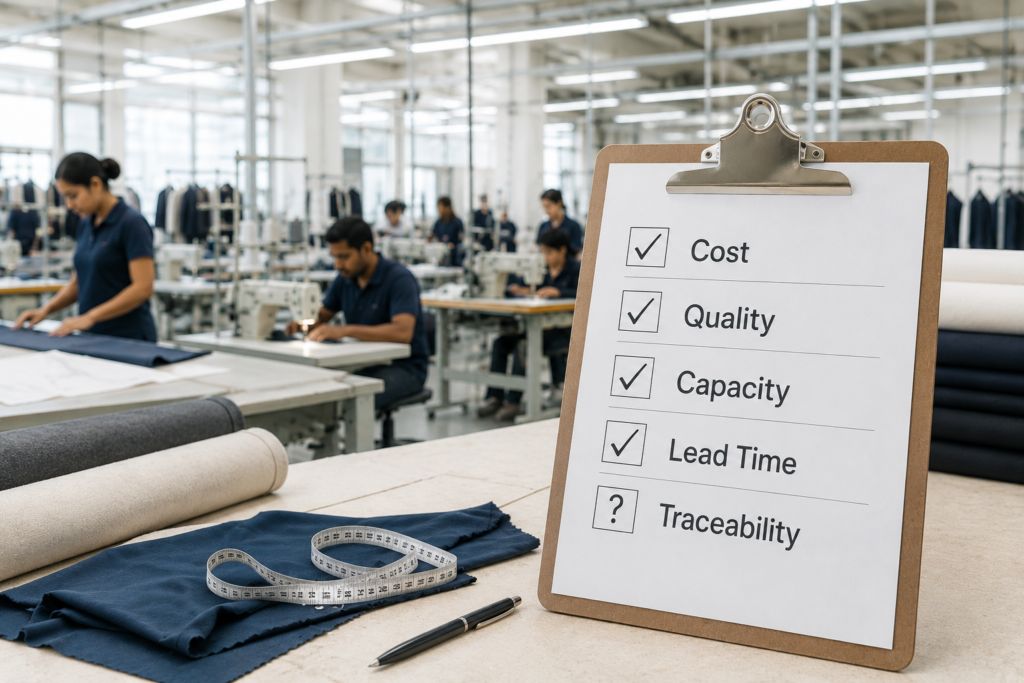
For a long time, supplier selection in fashion has come down to a familiar set of questions.
Can they make it?
Can they make it at the right price?
Can they meet the quality requirements?
And can they deliver it on time?
All of those still matter.
But we think another question is becoming harder to ignore:
How well can they tell us what is actually happening across the supply chain?
That question is becoming more relevant as fashion sourcing itself changes.
At Source Fashion in London this summer, FashionUnited reported that buyer conversations were increasingly centred around longer-term sourcing strategies, with traceability, supply-chain resilience, durability, flexible production and nearshoring becoming part of the discussion alongside cost and sustainability.
That caught our attention.
Because if brands are beginning to evaluate suppliers through a wider lens, could traceability eventually become more than something they ask suppliers for?
Could it become something they use to choose between them?
Traceability as a capability, not just a requirement
For many brands, traceability has traditionally been connected to compliance, sustainability reporting or substantiating a particular claim.
A brand needs information about a material, so it asks its supplier for it.
A certification needs to be verified, so documentation is requested.
A sustainability claim needs evidence, so the supply chain is mapped.
Necessary, but often reactive.
The more interesting possibility is what happens when that information becomes structured, accessible and easier to use.
Instead of asking a supplier for information because a requirement demands it, a brand could start seeing the supplier’s ability to provide reliable information as part of its overall capability.
That is a subtle shift.
And we think it could become increasingly important.
Brands are asking more of their supply chains
This isn’t only about Digital Product Passports.
Brands are facing a broader need to understand where products come from, how they are made and whether the information behind their claims can be supported.
The Business of Fashion recently described traceability as becoming a business requirement for fashion brands as regulatory and trade pressures increase the need for greater visibility into supply chains.
That makes supplier information more than something that sits in a sustainability report.
It can help brands ask better questions:
Where are the gaps?
How confident are we in the information we’re receiving?
How quickly can we retrieve it?
And can we rely on it when making a sourcing decision?
The manufacturer side
Most traceability conversations focus on what brands need from their suppliers.
But there is another side to this.
For manufacturers, traceability is often presented as another requirement, another set of records to maintain, another request from a customer.
What if it could become part of the value they offer?
Imagine two manufacturers offering broadly similar price, quality and lead times.
One can provide consistent product and material information quickly, with clear documentation and traceability.
The other has to gather information manually from different people, suppliers and files every time a brand asks for it.
The product may be comparable.
But the ease and confidence of working with the supplier may not be.
That difference could increasingly influence sourcing decisions.
The data doesn’t start with the brand
This is particularly relevant to Digital Product Passports.
The European Commission describes DPPs as a way to improve access to product information and create more transparent value chains. The EU-level DPP Registry became operational on 20 July 2026, while the textile-specific requirements are currently expected to be developed through a delegated act planned for Q4 2027.
So the direction is clear:
Product information is increasingly becoming something that needs to be accessible across the value chain.
But the information behind a product does not start with the brand.
A fabric mill knows the composition of the fabric.
A dye house knows about the processes it carries out.
A material supplier may hold origin or certification information.
A manufacturer knows how those components come together.
This is why supplier engagement is such an important part of DPP readiness.
So if brands increasingly depend on suppliers for reliable product information, supplier data capability becomes part of the relationship itself.
But more data doesn’t automatically mean a better supplier
A sophisticated digital system doesn’t automatically make a supplier a better manufacturer.
And collecting more information doesn’t automatically create better decisions.
The value comes from information that is accurate, consistent, accessible and usable.
Otherwise, we’re simply creating more administration.
So perhaps the question isn’t simply:
“How do we get more data from our suppliers?”
But:
“How do we make the information already being created across the supply chain easier to connect and use?”
From compliance cost to commercial capability
This is the shift we find most interesting.
Traceability has often been positioned as something that costs brands and suppliers time and money.
But if the same information can help a brand make better sourcing decisions, identify risks earlier, substantiate claims and prepare for product-level requirements, its value becomes much broader.
The European Commission itself points to potential benefits of DPPs including supply-chain performance, efficiency, quality, compliance and market position.
For manufacturers, the ability to provide that information reliably could become a differentiator in its own right.
What could this mean for brands when selecting a supplier?
Cost, quality, capacity, expertise, lead time and established relationships will continue to shape sourcing decisions.
But as brands become increasingly dependent on suppliers for reliable product and supply-chain information, traceability could become another dimension of supplier capability.
Not a standalone criterion.
But one part of a broader assessment of supplier readiness.
The question may gradually move beyond:
“Can you make this product?”
to:
“Can you make it, and provide the information we need to understand it, substantiate it and manage it?”
That distinction could become increasingly relevant as product-level transparency becomes part of doing business in key markets.
And if traceability does become something suppliers compete on, rather than simply something they comply with, supplier selection could start to look a little different.
The fundamentals of good manufacturing will remain.
But the ability to provide reliable information could become part of how a supplier demonstrates the value it brings to its brand customers.
Building visibility without the complexity
For growing fashion brands, that raises another consideration:
How do you create this level of visibility without adding another layer of complexity to an already complicated product journey?
This is what we are working towards at DigiProPass®: helping fashion brands bring their product information and supply-chain traceability together, and turn it into Digital Product Passports that are easier to establish and manage. So information becomes a useful part of the product journey rather than another disconnected compliance exercise.
Because perhaps the real competitive advantage isn’t just having more data.
It’s being able to make the right information work harder.
We’d be interested to hear how brands and manufacturers are approaching this today. Let’s talk.