
Fashion Industry Trends 2026 How Traceability, Regulation, and Circularity Are Reshaping the Industry
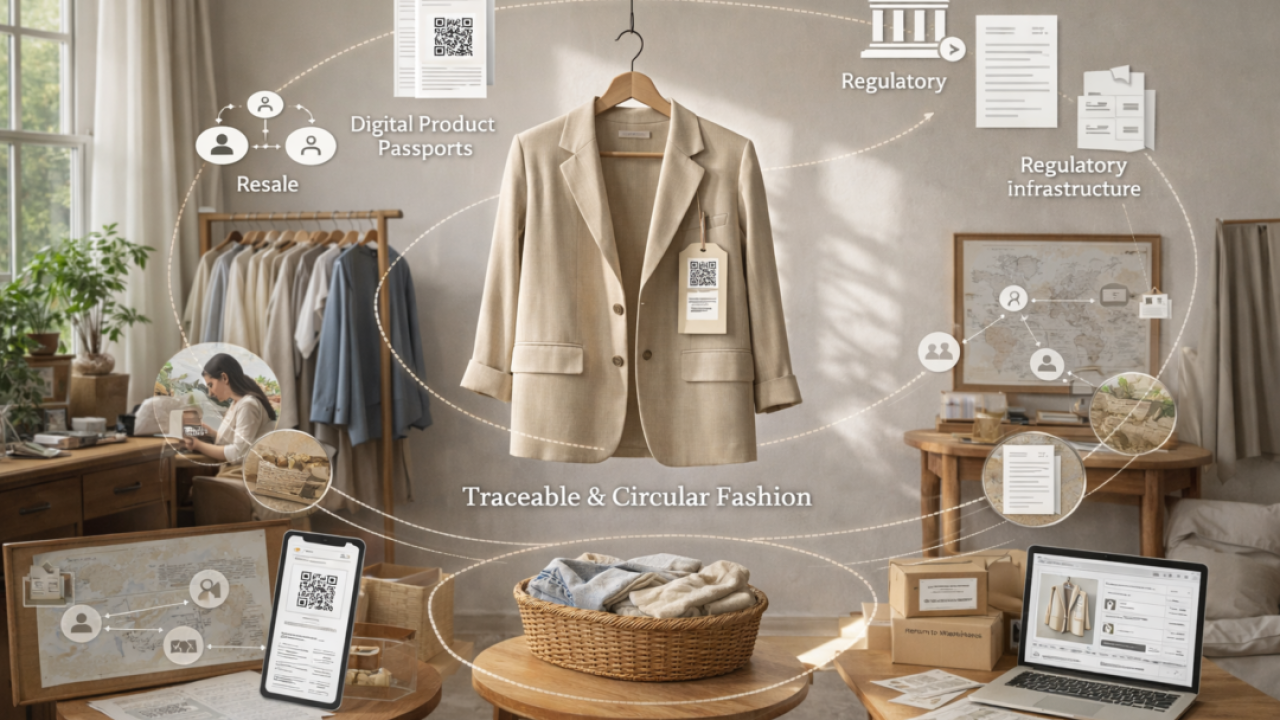
2025 marked a decisive turning point for the global fashion industry. After more than a decade of sustainability commitments, pilot initiatives, and aspirational language, the sector entered a new phase. This new era is defined by accountability, transparency, and execution. Regulation accelerated, and traceability became foundational. Circular business models moved into the commercial core while resale emerged as a critical growth and value-retention lever.
As brands close the year, the question is no longer whether these shifts matter, but how quickly organizations can adapt. Looking ahead, the fashion industry trends shaping 2026 point toward a more regulated, more transparent, and more value-constrained consumer landscape. The brands that succeed will be those prepared to operate with verifiable data, extended product lifecycles, and systems-level thinking.
This review examines the forces that reshaped fashion in 2025, and what they signal for the year ahead.
Regulation in the Fashion Industry: From Pressure to Enforcement
In 2025, regulatory momentum reached a critical threshold. The European Union advanced its Digital Product Passport (DPP) framework, establishing clear expectations for product-level data covering materials, sourcing, recyclability, and environmental impact. For many brands, DPP readiness shifted from long-term planning to an immediate operational priority, elevating traceability and data governance to the executive agenda.
Regulatory pressure also intensified in the United States. Legislative progress in New York and California signalled that fashion accountability requirements are no longer geographically isolated. Brands increasingly prepared for scrutiny across the full value chain, including labor practices, emissions, chemical management, durability, and end-of-life responsibility.
From a commercial perspective, regulation is now reshaping competitive dynamics. Industry research from McKinsey highlights that new sustainability and product-related rules are forcing brands to rethink business models and supply chains. Organizations with compliance-ready data systems are emerging with a structural advantage, able to respond faster, report more credibly, and operate with reduced regulatory risk.
Fashion Traceability Became the Foundation for Strategy and Growth
If 2023 and 2024 were years of discussion, 2025 was the year fashion traceability became operational. Brands reached a clear conclusion: without verified, end-to-end visibility into materials, suppliers, and product lifecycles, sustainability claims and regulatory compliance efforts cannot withstand scrutiny.
Traceability also evolved into a commercial capability. Consumers increasingly expect proof behind marketing claims, particularly around sustainability and ethical sourcing. Recent Mintel research shows that authenticated product information, credible sustainability data, and transparent supply chains now play a central role in building trust and driving purchase intent. The impact is especially clear in fashion and luxury markets.
As a result, investment in scannable product passports and integrated data systems accelerated rapidly. These systems are now built to support compliance reporting, consumer engagement, and circular business models simultaneously. In 2025, traceability shifted from a back-office requirement to a front-facing value driver.
Circular Fashion and Resale Models Became Core Business Strategies
Circularity moved decisively from niche experimentation to commercial strategy in 2025. According to TheIndustry.fashion, brands showing stronger performance recovery were those capturing value beyond the first transaction through resale, repair, rental, and take-back programs.
This transition was driven by mounting economic pressures. Inventory volatility, rising raw-material costs, tariff uncertainty, and margin compression forced brands to identify new sources of value. Circular fashion models delivered measurable returns, generating incremental revenue, increasing repeat engagement, and lowering customer acquisition costs.
Perhaps the most notable shift was philosophical. Circularity was no longer positioned as a sustainability trade-off or brand halo. Instead, it emerged as a margin stabilizer and a long-term growth mechanism, one that aligns commercial performance with operational resilience.
Resale Infrastructure Became Essential for Fashion Brands
Resale continued to outperform every other growth channel in 2025, reinforcing its role as essential infrastructure rather than a peripheral experiment. Data from The State of Fashion 2026 illustrates the scale of this shift:
- 43% percent of consumers who discover a brand through resale later purchase new products
- The global secondhand market is projected to reach approximately $317 billion by 2027
- Nearly 60% of consumers cite rising retail prices as a primary driver toward secondhand purchases
- Despite rapid growth, fewer than 300,000 brand-operated resale listings exist compared to more than 40 million listings on peer-to-peer platforms, underscoring how underdeveloped brand-owned resale remains
ThredUp’s 2024 Resale Report further reinforces this trajectory, projecting the global secondhand market to approach $350 billion by 2030 and grow at three times the rate of traditional retail.
For fashion brands, the implications are clear. Resale is now a baseline consumer expectation and a strategic lever for customer lifetime value, pricing flexibility, and circular engagement.
Regenerative Commerce and Systems-Level Fashion Brands Emerged
A defining shift in 2025 was the rise of regenerative commerce. This approach moves beyond minimizing harm and toward business models where each transaction contributes to ecological restoration, material recovery, or community resilience.
Commentary on brands such as Patagonia has framed this evolution succinctly: the long-term leaders in fashion will not simply sell products, but systems of survival. With climate-driven displacement projected to reach up to 1.2 billion people by 2050 and research showing that a majority of Gen Z consumers prioritize purpose-driven companies, regenerative thinking is increasingly shaping competitive advantage.
In practice, this shift is already underway. Brands are piloting regenerative agriculture sourcing, biodiversity restoration partnerships, and repair-first operating models. In 2026, more companies are expected to reposition around ecosystems and outcomes rather than product categories alone.
Fashion Industry Trends 2026: From Preparation to Execution
If 2025 was the year of preparation, 2026 will be defined by execution. Several themes are emerging as critical for fashion brands navigating the next phase:
Compliance as an Operational Capability: Regulators will increasingly require verifiable, product-level data submissions. Brands lacking digital product identity and traceability systems will face growing operational and financial risk.
Resale Embedded Across Retail Channels: Resale, trade-in, and authenticated secondhand are expected to integrate directly into e-commerce, physical retail, and loyalty ecosystems.
Multi-Tier Supply Chain Transparency: Visibility beyond Tier 1 suppliers will become essential for Digital Product Passport compliance and supply chain risk management.
Regenerative and Restorative Revenue Models: More brands will link portions of revenue to measurable ecological or community outcomes, embedding purpose directly into business mechanics.
A Shift From Growth-at-All-Costs to Value Preservation: Resilient brands will prioritize extending product life, recirculating materials, and unlocking new value pools over increasing production volume alone.
Frequently Asked Questions: Fashion Trends and Sustainability
What are the most important fashion industry trends for 2026?
Key fashion industry trends for 2026 include digital product passports, expanded traceability, integrated resale models, circular fashion strategies, and increased regulatory enforcement.
What is the Digital Product Passport in fashion?
The Digital Product Passport is a regulatory framework requiring fashion brands particularly within the European Union to provide product-level data. This includes details on materials, sourcing, environmental impact, and end-of-life pathways.
Why is resale important for fashion brands?
Resale supports customer lifetime value, meets growing demand from price-conscious consumers and reduces waste. It also creates new revenue streams aligned with circular business models.
Reshaping Fashion’s Value System
The fashion industry is entering a new era defined by traceability, accountability, circularity, and long-term resilience. These shifts are not temporary responses to regulatory pressure but structural changes reshaping how value is created and preserved.
Every product will increasingly require a digital identity. Every sustainability claim will require verifiable proof. And every brand will need a credible strategy to extend product life, reduce waste, and participate meaningfully in a circular economy.
For organizations preparing for the next phase of transformation, now is the time to invest in the systems, partnerships, and data foundations that will define competitive advantage in 2026 and beyond.
Brands that act decisively will be best positioned to navigate regulation and build consumer trust. They will also unlock durable growth in a rapidly evolving fashion landscape.
DigiProPass helps fashion brands move from reactive sustainability to a proactive, design-led approach to circularity. Our Digital Product Passport platform gives teams clear visibility into materials, production, and supply chains. It supports regulatory readiness while enabling smarter design, longer product life, and reduced waste.
By combining product intelligence with customer-facing repair, care, and transparency tools, brands unlock stronger trust and meaningful circular resale and surplus pathways.
DigiProPass also makes it easier to communicate measurable impact.
Ready to move from pilot to practice? Book a call to explore how DigiProPass can help you scale Digital Product Passports with confidence