
The First 30 Days of a Digital Product Passport What Fashion Brands Don’t Expect
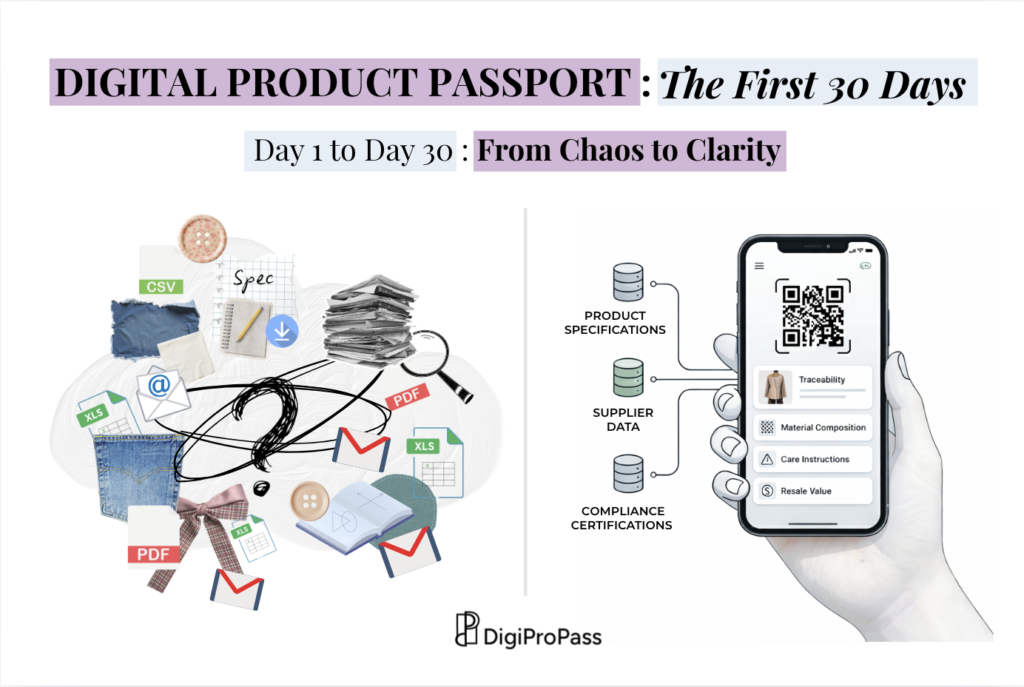
Most fashion brands aren’t ignoring Digital Product Passport (DPP). They’re trying to understand where to begin and how much needs to be in place before they do.
While the direction is clear, the starting point often isn’t.
Over the past few months, the DPP conversation has evolved. We’ve explored this shift from multiple angles from compliance requirements to the broader role product data plays in customer relationships, retention, and brand trust.
This piece takes a more practical lens:
What actually happens in the first 30 days once a brand decides to get started?
The Context Brands Are Navigating
Digital Product Passports are no longer theoretical. If you’ve been following the evolving regulatory landscape, you’ll already be familiar with where this is heading. For those newer to the space, Digital Product Passports are being introduced under the EU’s Ecodesign for Sustainable Products Regulation (ESPR) framework, with phased implementation expected across categories like textiles from 2027.
That leaves the industry with a relatively short window to prepare.
Most brands understand why DPPs matter.
What they’re navigating is how to start without overbuilding systems or delaying progress.
This shift is already visible across the industry.
At the luxury end, adoption is well underway. According to a Vogue Business and Certilogo study, 67% of the top global luxury fashion brands have already adopted some form of Digital Product Passport or authentication solution, signalling that early movers are already taking action.
At the same time, this shift is not limited to large luxury players. As highlighted in The Business of Fashion and McKinsey & Company’s State of Fashion, digital transformation and traceability are becoming priorities across the wider fashion industry.
As regulatory expectations evolve, this is becoming increasingly relevant for fashion brands selling into the EU market, regardless of size, where traceability and product transparency are shifting from a differentiator to a requirement.
“The immediate challenge is no longer awareness. It is execution.”
Week 1: The Data Isn’t Missing, It’s Fragmented
One of the first realities fashion brands encounter is this:
The data isn’t missing. It’s fragmented.
It already exists across:
- supplier emails
- spreadsheets
- internal documents
- legacy systems
What’s missing is structure.
Inconsistent naming conventions, incomplete fields, and disconnected sources make the data difficult to use, even when it’s technically available.
This is where many brands lose momentum early.
Because the instinct is to gather more, when the real need is to organise what already exists.
You’re not starting from zero.
You’re starting from fragmentation. And that’s a far more manageable place to begin.
Week 2: Structure Is a Business Decision, Not a Technical One
Once visibility improves, the instinct is to aim for completeness.
Full traceability.
End-to-end data.
Perfect standardisation.
Complete system integration.
This is where complexity begins to build.
The more effective approach is simpler:
structure what is needed first and expand from there.
Because deciding what to prioritise is not just a technical step.
It’s a business decision.
It requires clarity on:
- what supports compliance in the near term
- what creates immediate customer-facing value
- what can evolve over time without blocking progress
In practice, progress comes from activation, not perfection.
The brands that move early are rarely the ones with the most complete data.
They’re the ones with the most usable systems.
Week 3: The Moment It Becomes Real
Up until this point, everything is internal.
Then suddenly, it isn’t.
The shift from internal preparation to external visibility happens quickly.
A QR code is generated.
A product passport exists.
Information becomes accessible.
At that point, the role of product data begins to change.
It is no longer just operational.
It becomes customer-facing.
This is where expectations start to shift.
The focus moves beyond accuracy to clarity, relevance, and usability.
Once information is visible, it is no longer just documentation.
It becomes part of the product experience.
Week 4: The Reframe
By Week 4, a different perspective starts to take shape.
What began as a compliance initiative starts intersecting with:
- marketing
- customer experience
- retention
And this is where a gap becomes visible.
The data is structured.
The passport exists.
It works as expected.
But it remains passive.
At this stage, many brands realise that while they’ve built the foundation, they haven’t yet defined how it contributes to value creation.
What Becomes Clear by Day 30
By the end of the first month, most brands arrive at the same realisation:
Getting product data structured is only the first layer.
The real opportunity lies in what that data enables next.
Because once the infrastructure exists, the question changes from:
“Do we have the data?”
To:
“How does this data participate in the customer journey?”
This is where the hidden ROI of DPPs begins to emerge.
Not in compliance, but in connection, retention, and repeat interaction.
A Shift That’s Already Underway
This shift isn’t a future behaviour. According to research from Avery Dennison and GWI, two-thirds of global fashion consumers want more transparency about where and how their garments are made.
But expectations are already moving beyond transparency.
Post-purchase engagement is becoming increasingly important, with growing interest in:
- care and maintenance
- product longevity
- repair options
- resale pathways
Digital Product Passports don’t introduce these behaviours.
They bring them together into a single, accessible layer.
In doing so, they extend the role of product data beyond compliance, into something far more continuous and customer-facing.
And brands that treat DPPs purely as a compliance layer risk missing this shift entirely.
Closing Thought
The first 30 days of a Digital Product Passport are not about completion.
They’re about clarity.
Clarity on:
- how fragmented product data really is
- how strategic structure needs to be
- how quickly compliance can evolve into a growth lever
What matters is not how much data exists, but how effectively it is used once it becomes accessible.
Where DigiProPass Fits In
For most brands, the challenge isn’t understanding Digital Product Passports or adding another system. It is getting started without overengineering, overinvesting, or waiting for perfect data.
DigiProPass is built to support that transition. It helps brands move from fragmented data to structured, usable product passports in a simple and practical way.
The focus is simple:
start with what exists, make it usable, and build from there.
The first 30 days are where momentum is built.
Don’t wait to be ready, start your Digital Product Passport today and turn your product data into a growth lever that drives customer engagement and value from day one.