
From QR Codes to Customer Retention How Fashion Brands Unlock the Hidden ROI of Product Data
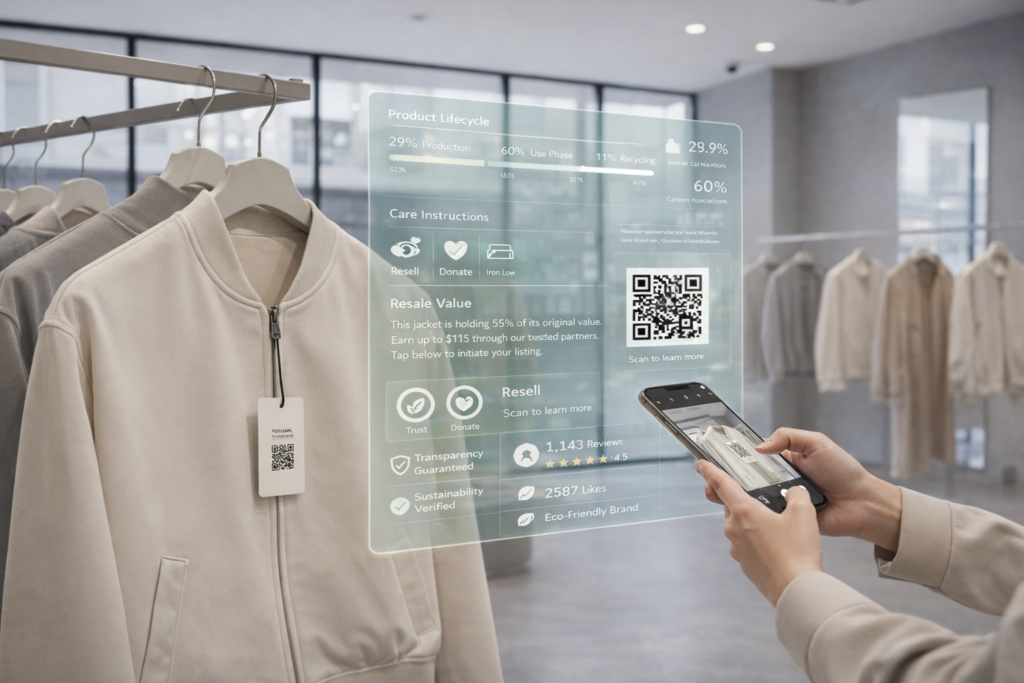
Digital Product Passports are steadily becoming part of everyday conversations in fashion. They surface through regulation, sustainability commitments, and increasingly through customer expectations. What’s clear is this: product data no longer sits quietly in internal systems. It is visible, accessible, and beginning to play a more active role in how brands connect with customers.
For many fashion brands, this shift has been enabled through simple touchpoints – most commonly QR codes on labels or packaging. What began as a way to share sustainability or compliance information is gradually evolving into something more strategic: a post-purchase connection between the product, the brand, and the customer.
What’s still less explored is the return on investment (ROI) of this connection, and how Digital Product Passports can function not just as disclosures, but as long-term customer retention and relationship assets.
Where Digital Product Passports Sit Today
At their core, Digital Product Passports give products a digital identity. They bring together information on materials, sourcing, care, and lifecycle, and make that information accessible to customers, partners, and regulators alike.
In practice, most DPP initiatives today are driven by necessity. In most conversations I’ve had with fashion founders, the initial motivation for DPP implementation is clear:
“We want to meet upcoming requirements, and we’re racing to gather data from suppliers.”
From 2027, DPPs will become mandatory for textiles under the EU Ecodesign for Sustainable Products Regulation (ESPR). By 2030 nearly every physical product sold in the EU will require one. Traceability, transparency, and regulatory alignment are therefore the natural starting points.
Structuring product data across suppliers, collections, and regions is no small undertaking. In many cases, however, the customer-facing layer of the DPP stops at transparency. The passport exists. It can be accessed. The information is accurate.
But it remains disconnected from how brands design customer experience, drive repeat engagement, or increase customer lifetime value.
This is where the hidden ROI of product data begins to surface.
A Subtle Shift in Customer Behaviour
What’s changing quietly but meaningfully is how customers engage with product information after purchase. Interaction with product data is no longer limited to validating claims. It increasingly relates to care, longevity, repair, and resale.
This behaviour is already measurable. In a 2023 study by Avery Dennison and GWI, six in ten fashion shoppers globally said they see value in scanning a QR code on a garment to understand how to care for it.
Research consistently shows that access to detailed product information increases consumer trust, with 71% of shoppers saying DPP makes brands more trustworthy, and nearly half expecting stronger loyalty as a result. Digital Product Passports don’t introduce a new behaviour. They consolidate existing ones into a single, reliable access point.
What matters isn’t the technology itself. Customers engage when the information helps them extend the life of a product, verify its authenticity, or better understand its value over time. These moments are where product data begins to translate into retention.
The Gap Between Compliance and Commercial Use
Many brands approached DPPs as a regulatory inevitability, a requirement to be met. But in the process of implementing them, something unexpected emerged. As product data became structured, verified, and accessible, it revealed a capability beyond compliance.
As one founder told me,
“We thought our job was done once the data was uploaded and accessible. Only later did we realise we had built a channel we weren’t actually using.”
This insight reflects a broader industry shift, from compliance to commercial relevance. And this shift is supported by data: a recent Bain & Company + eBay report found that DPPs could double the lifetime value of products, with up to 65% of that new value captured by consumers through resale and services connected to verified product histories.
Beyond resale economics, this highlights something more fundamental: trust, transparency, and sustained engagement, all of which contribute directly to customer retention.
Where Retention Enters the Picture
Customer retention in fashion has traditionally relied on marketing-led tools: loyalty programmes, newsletters, or targeted campaigns. DPPs introduce a different dynamic: retention through utility.
When a customer returns to scan a product to understand how to care for it, verify its authenticity, or explore resale options, the brand re-enters the conversation organically. These meaningful interactions are grounded in the product itself, not marketing prompts.
This dynamic is particularly relevant for small and mid-sized brands. You don’t need scale to unlock ROI from DPPs. You need intentional use of product data after checkout.
When designed this way, Digital Product Passports become part of the brand experience, not just a regulatory requirement.
Turning Product Data into a Relationship Asset
The brands seeing the most value from DPPs are not necessarily the biggest ones. They are the ones asking clearer questions:
- How does this data help our customer once they own the product?
- When does the product re-enter their daily life?
- What information actually builds confidence or removes friction?
Often, the answers are practical rather than technical: clearer care guidance, verified provenance, authenticated repair and resale pathways, or structured lifecycle information. These aren’t flashy innovations, but they are powerful in building long-term relationships.
When Digital Product Passports are built around real customer moments, QR codes stop being passive labels and start functioning as relationship infrastructure.
This is where the ROI of product data becomes visible, quietly and consistently.
Where DigiProPass Comes In
At DigiProPass, we see this shift firsthand. Brands often begin with compliance in mind, but quickly realise that the same DPP infrastructure can support customer engagement, retention, and circular strategies, if it’s designed with purpose.
By helping brands structure and activate their product data through Digital Product Passports, DigiProPass enables QR codes to function as more than access points. They become part of how brands stay present throughout a product’s lifecycle.
Looking Ahead: Product Data as a Long-Term Strategy
Digital Product Passports are no longer a future concept. They’re already shaping how fashion brands think about transparency, trust, and long-term value. When brands shift from asking “What do we need to disclose?” to “How does this help our customer?”, DPPs move from obligation to advantage.
If you’re exploring how Digital Product Passports can deliver measurable ROI beyond compliance and how product data can strengthen customer retention, let’s talk!