
Latest DPP Methodology 5 Things Fashion Brands Need to Know
Most DPP conversations in fashion are stuck on what to collect.
The EU JRC’s methodology published last month answers a different question first: Why the data is needed at all.
That distinction matters more than most brands realise, it shifts how this needs to be approached.
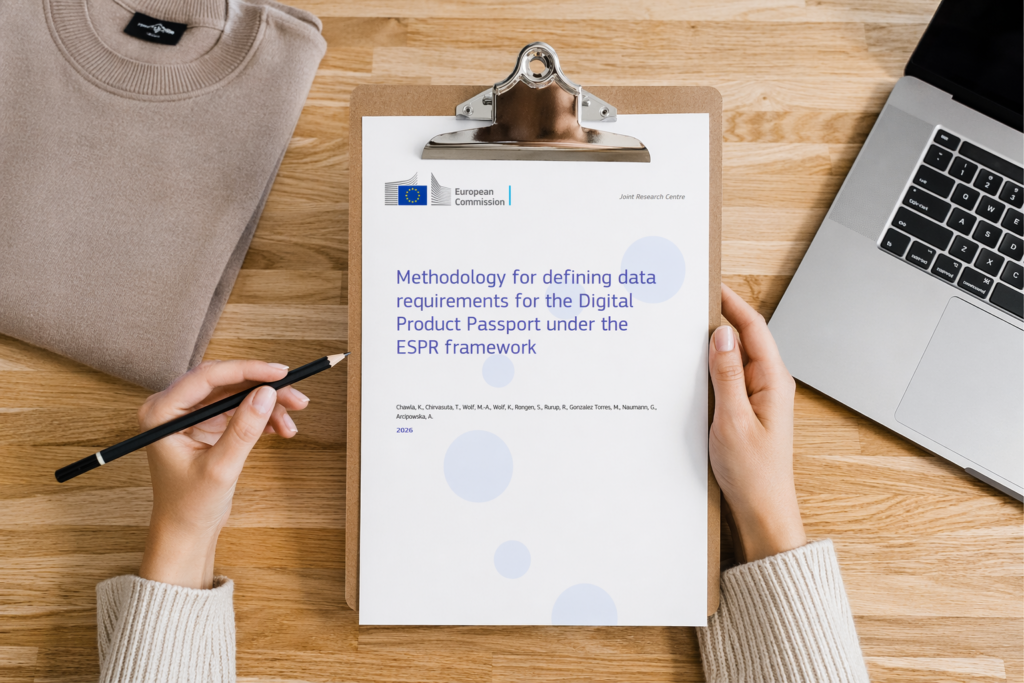
At 121 pages, the JRC methodology sets the foundation for how Digital Product Passports will be defined across industries under the Ecodesign for Sustainable Products Regulation (ESPR).
A lot has already been shared and discussed.
But if you’re a fashion brand, it can still leave a gap: How this translates into something practical.
That’s where we’ve taken a slightly different approach.
We spent time decoding it through one specific lens:
What does this actually mean for fashion brands, and what can be acted on today?
Here’s what stands out.
1. Data follows use cases, not the other way around
This is the most important (and most missed) point in the entire document.
The methodology doesn’t start with “what data should be collected.”
It starts by defining use cases first, then identifying data needs from there (Section 3.3, p.40-45, based on the document’s internal numbering).
Think about why that matters in practice.
- A recycler accessing your DPP needs fibre composition and disassembly instructions.
- A consumer needs care and repair guidance.
- A regulator needs substance declarations.
Same product. Three completely different data needs.
Without a clear use case, even good data becomes noise.
Before you structure anything, ask:
Who is this for and what decisions should this data enable?
2. You don’t need all the data, just the right data
The methodology explicitly categorises data into priority levels (essential, recommended, voluntary) based on value and feasibility, not based on what’s theoretically possible to collect (Executive Summary, p.6).
This is a strong signal about how the system has been designed: around real industry conditions, not ideal ones.
What this means in practice: you don’t need a perfect, fully mapped supply chain to begin.
Most of the data already exists, just scattered across different places:
- Mills and Fabric Suppliers
- CMT units
- PLM/ERP systems (where in place)
- Internal spreadsheets used across sourcing and product development
- BOMs / Specs / Declarations
The challenge isn’t absence, it’s structure and consistency.
Start with what is most relevant and usable. Not everything that could exist.
3. Granularity is a strategic choice (not a default)
Defining data granularity (model, batch, or item level) is treated as a deliberate design decision, not a default (Section 3.4.3, p.50).
This matters for fashion because a brand running 200 SKUs of basics has entirely different starting requirements than one producing limited drops with unique materials per batch.
Neither is wrong, they’re just different, and the framework accounts for that.
Not every brand needs item-level traceability from day one.
Starting simpler doesn’t mean falling behind.
It often means moving faster.
4. One product, multiple users
The DPP is designed to serve different actors across the value chain, with differentiated access rights depending on who’s looking (Section 2.2.1, p.14; access principles p.107–110).
Consumers, repairers, recyclers, and regulators all access the same product, but they need different things from it.
To bring this to life:
The methodology includes a worked example of a consumer scanning a QR code on a hoodie with a broken zipper. The DPP surfaces the exact zipper specification, down to “YKK #5 nylon coil”, along with repair diagrams and tutorial links. That’s not hypothetical. That’s the level of specificity the framework is being built around.
Your DPP isn’t just a compliance layer. It’s a multi-user system.
And how you design it should reflect that from the start.
5. This is a living system, not a one-time setup
The methodology includes validation, updates, and lifecycle-based data changes as core parts of the design (Step D, p.54; p.112–114).
Product data doesn’t stop at production.
It evolves through use, repair, resale, and end-of-life.
DPPs are designed to change, because products do.
This is worth sitting with.
Brands that treat DPP implementation as a one-time project will find themselves rebuilding constantly.
Brands that treat it as a system, something that evolves, will find it far more manageable.
So where does that leave fashion brands right now?
Not needing to do everything at once. Just a few grounded steps:
- Identify what data you already have
- Clarify your key use cases (and who they serve)
- Structure a small, usable dataset around those
- Start with one product or one category
The methodology brings structure.
But how you approach it will define whether this feels manageable or overwhelming.
And right now, the biggest advantage isn’t having everything figured out. It’s starting in a way that’s simple enough to build on.
This is something we care deeply about at DigiProPass, making DPPs feel practical, progressive, and manageable for growing fashion brands.
If you’re figuring out what this could look like for your products, you can book a time with us here or reach out at support@digipropass.com.
Happy to think this through with you.